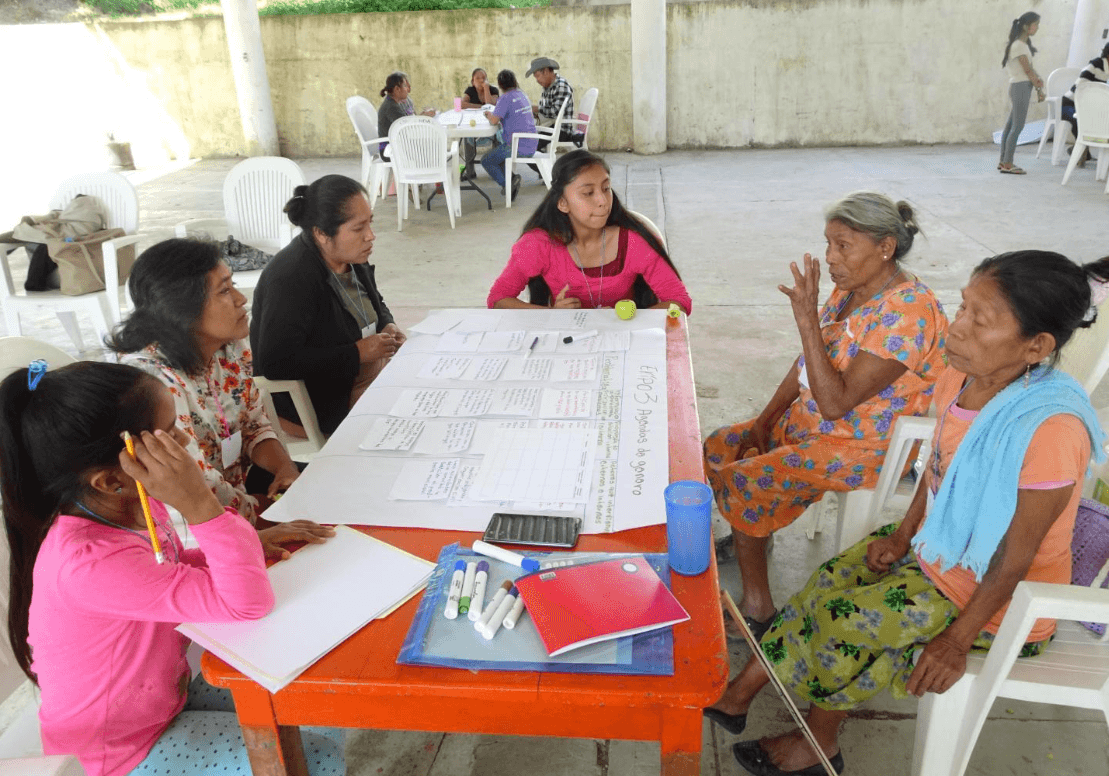
Note: This blog draws on civil society peer-learning conversations convened by the Trust, Accountability and Inclusion (TAI) Collaborative. Discussions were held under the Chatham House Rule; the insights presented here are synthesized thematically and are not attributed to individual participants.
What does it take for organizations working on economic justice, gender equality, land rights and environmental protection to collaborate effectively? And what role can funders play in making that collaboration possible?
These questions shaped a peer-learning conversations convened by the Trust, Accountability and Inclusion (TAI) Collaborative bringing together participants from across Latin America, Africa, Asia-Pacific, Europe and North America working on Gender and Rights in the Economy and Natural Resource Rights.
Participants represented Indigenous organizations, land and tenure coalitions, labor federations, fiscal justice and financial transparency networks, human rights advocacy groups, women's rights and climate organizations, alongside a small number of intermediary funders. All are grantees of a rights and social and economic justice funder but split across different portfolios. As the fund winds down, it has prompted a reflection on what have been useful bridging across those separate domains.
We opened with a simple poll. We asked which challenge felt most urgent: climate and gender intersections, fiscal governance, corporate capture, funding cuts, or civil society solidarity.
The votes split almost evenly across the board.
That balance revealed a fundamental truth: there is no single gateway issue. For communities protecting ancestral lands, trade unionists fighting for living wages, and tax justice campaigners challenging illicit financial flows, the intersections are the work. Yet our funding ecosystem remains rigidly compartmentalized into issue silos and short-term deliverables.
The conversation quickly moved beyond individual themes to a more fundamental question: what conditions make collaboration possible, and what prevents it from taking root?
Collaboration is a survival strategy, not a nice-to-have
One of the strongest messages from the discussion was that collaboration should not be treated as an optional addition to organizational strategies. It is essential to whether organizations can access resources, influence decisions and sustain their work.
Participants challenged the familiar question of how much collaboration costs. Instead, they asked what it costs not to collaborate. The answer was clear: while working separately may appear manageable in the short term, fragmentation can become self-defeating over time.
Indigenous organizations described how competitive funding processes often place them at a disadvantage compared with larger, more specialized NGOs. For these organizations, building alliances is not simply a preferred approach to working; it can be the only viable way to access resources and exercise influence.
Yet much of the collaboration taking place today remains temporary and reactive. Organizations come together around a particular advocacy moment, coordinate their activities and then disperse. Relationships rarely develop into sustained partnerships, and collaboration often fails to reach the country and subnational levels where decisions directly affect people's lives.
What is missing is the infrastructure that enables collective action to endure: relationships, trust, shared intelligence, joint analysis and the capacity to coordinate across movements. However, this connective infrastructure remains largely unfunded and unmeasured.
The real cost of collaboration is often invisible
Funders typically support defined themes, strategies and projects. The work required to connect them, however, is much less likely to receive dedicated funding. As a result, organizations absorb the costs of maintaining relationships, coordinating across networks, sharing information and developing common positions. This work is essential to collective influence, but it often remains invisible in budgets and unrecognized in reporting.
Occasional conferences cannot fill this gap. While they offer opportunities to connect, their frequency, cost and accessibility limit their potential to sustain inclusive collaboration.
Participants highlighted the value of more regular, accessible spaces where organizations can build trust, exchange intelligence and develop joint strategies. Stronger connections can help movements respond more quickly to emerging challenges, enable workers and community organizations to access decision-making spaces they might otherwise be excluded from, and increase their collective influence.
For funders, the implication is straightforward: supporting collaboration requires investing in the relationships and systems that make it possible, not just the activities that result from it.
Shorter funding horizons are reshaping civil society
Participants described a funding environment increasingly characterized by short commitments, with funding cycles of 12, 18 or 24 months becoming more common. This makes it difficult for organizations to plan for the long term, maintain partnerships or invest in the capacities needed to influence complex policy processes.
Funding volatility also affects how organizations define their work.
As donor priorities shift, organizations may need to adapt their language, strategies or thematic focus to remain eligible for support. One network described how financial transparency became less prominent in funders' priorities, prompting it to emphasize the connections between issues such as care and taxation, climate change and illicit financial flows.
Such adaptations can generate valuable new approaches. But when they are driven primarily by changing funding preferences rather than by an organization's own strategic assessment, they risk distorting priorities and weakening the wider ecosystem.
Participants also warned that funders who lack a clear understanding of the organizations and relationships within a field can inadvertently undermine it. Competitive funding processes may concentrate scarce resources in a single organization, increasing its size and prominence while weakening the broader network on which collective action depends.
The issue is therefore not simply how much funding is available. It is also how funding is structured, how priorities are set and whether decisions strengthen or fragment the ecosystem over time.
Complex challenges require interdisciplinary responses
Many of the issues participants are working on cannot be addressed through a single discipline or thematic portfolio.
International negotiations on tax, for example, may require international lawyers, economists, organizers, communicators and affected communities to work together. Each brings a different form of expertise, and each is necessary to connect technical negotiations with political mobilization and lived experience.
Yet funding structures often divide support by discipline, theme or organizational mandate. This makes it difficult for coalitions to assemble the combination of expertise needed to engage effectively in complex policy processes.
The consequences can be significant. Civil society organizations may invest years building momentum for a negotiation, only to find that the resources needed to sustain engagement through the final stages are unavailable.
Participants emphasized that supporting advocacy around a policy process is not enough. If funders want to see meaningful outcomes, they also need to support the coalitions, interdisciplinary teams and sustained engagement required to achieve them.
The same principle applies to work at the intersection of land rights, women's tenure security, climate and conservation. Guidance for donors on these issues already exists, participants noted, but institutional rules and funding restrictions can prevent it from being applied in practice.
This points to a broader challenge: better guidance alone will not produce change if funding institutions lack the flexibility to act on it.
What participants want funders to do differently
Across the discussion, participants identified several practical changes that could help make collaboration more sustainable and effective.
1. Fund connective infrastructure. Support the relationships, networks, alliances, coordination capacity and shared systems that allow organizations to work together over time. Recognize these as essential components of effective strategies, rather than incidental overheads.
2. Make the real costs of collaboration visible. Allow organizations to budget for coordination, relationship-building, joint analysis and collective learning. If these activities are necessary to achieve results, they should be reflected in funding decisions and reporting requirements.
3. Create spaces for organizations to develop proposals together. This was one of the most concrete requests to emerge from the conversation. Participants called for facilitated opportunities to co-develop collaborative proposals, supported by funders willing to encourage joint approaches. Reverse calls for proposals were suggested as one possible mechanism, alongside alternatives to competitive processes that place potential allies in opposition to one another.
4. Extend funding horizons. Provide multi-year, flexible support that allows organizations to build relationships, adapt to changing circumstances and pursue long-term strategies. Short-term project funding is rarely sufficient to sustain the infrastructure on which collective action depends.
5. Have honest conversations about the funding landscape. Participants want more direct dialogue with funders about changing priorities, funding withdrawals, the scale of the current crisis and the risk of losing entire areas of activism, including gender and fiscal justice. Greater transparency would help organizations make informed decisions and anticipate changes rather than respond to them after the fact.
6. Understand the ecosystem before allocating resources. Map the organizations, relationships, capacities and gaps within a field before making funding decisions. Participants described ecosystem mapping as a basic form of due diligence that can help funders avoid unintentionally concentrating resources or undermining existing collaboration.
7. Create cross-portfolio and interdisciplinary funding opportunities. Enable coalitions to bring together the expertise required to engage in technically complex policy arenas. This means making collaboration across thematic and institutional boundaries possible in practice, not just encouraging it in principle.
8. Measure contribution, not just attribution. Assess changes in collective capacity, relationships, power and access, rather than focusing exclusively on what an individual organization can claim. Ask what became possible because the wider infrastructure existed and how collective efforts contributed to broader change.
9. Address barriers facing grassroots and Indigenous organizations. Ensure Indigenous perspectives are recognized in donor decision-making and acknowledge the connections between land-related violence, economic resources and the ability of communities to exercise their rights.
10. Engage with the challenge of corporate capture. Participants called for a dedicated conversation on how funders can support more accountable private-sector conduct, particularly as corporate power grows and multilateral accountability mechanisms face increasing pressure.
Taken together, these recommendations point towards a different approach to funding: one that recognizes the health of an ecosystem as a condition for achieving impact, rather than treating organizations as isolated recipients competing for limited resources.
From conversation to collective action
The discussion also highlighted an important opportunity. Participants were not simply asking for more spaces to exchange experiences. They wanted opportunities to build something together.
Two possible next steps emerged.
The first is a funder-facing conversation focused on connective infrastructure, longer funding horizons and ecosystem mapping. This would create an opportunity to examine how funding practices can better support the conditions needed for sustained collaboration.
The second is a proposal-building space where organizations can develop collaborative approaches together, with funder sponsorship to make the process viable. This responds directly to participants' call for practical mechanisms that move beyond discussion and help translate shared priorities into joint action.
Participants also expressed interest in continuing the exchange and offered to share resources that could inform future work, including guidance for funders working across land rights, women's tenure security, climate and conservation.
The underlying message is that collaboration cannot be expected to emerge simply because organizations share common goals. It requires time, resources, trust and institutional arrangements that reward collective action rather than competition.
One phrase from the conversation captured this spirit particularly well: “Friendsraising over fundraising.” The expression reflects a broader ambition to build the relationships and solidarity that allow organizations to work together, even in a difficult funding environment.
For funders seeking to support lasting change across economic justice, gender equality and environmental protection, the challenge is to make that ambition possible. That starts by recognizing that the infrastructure connecting organizations is not peripheral to their work. It is part of what makes their work effective in the first place.